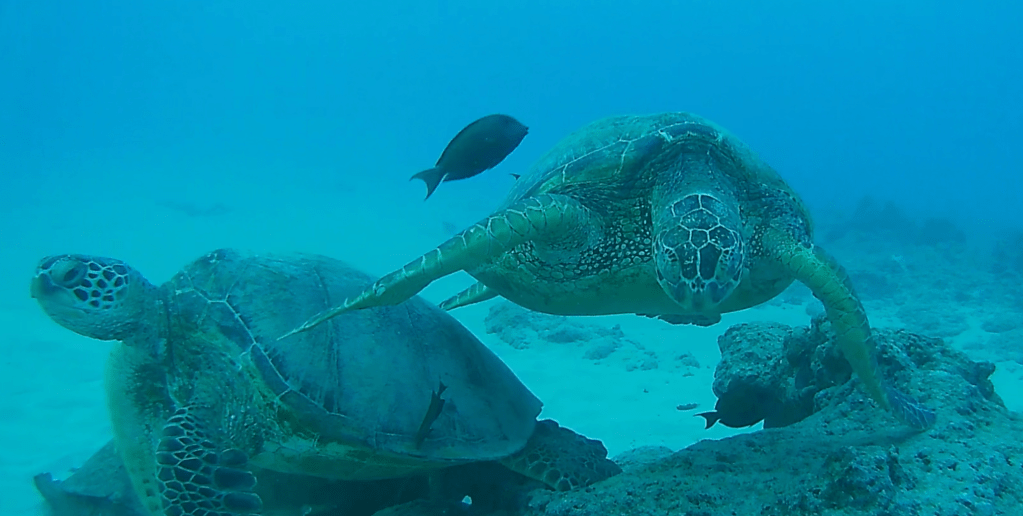
I was fortunate enough to be with multiple Honu throughout my adventures to Hawaii with even an opportunity to swim with them, which admittedly might be the coolest thing I have ever done.
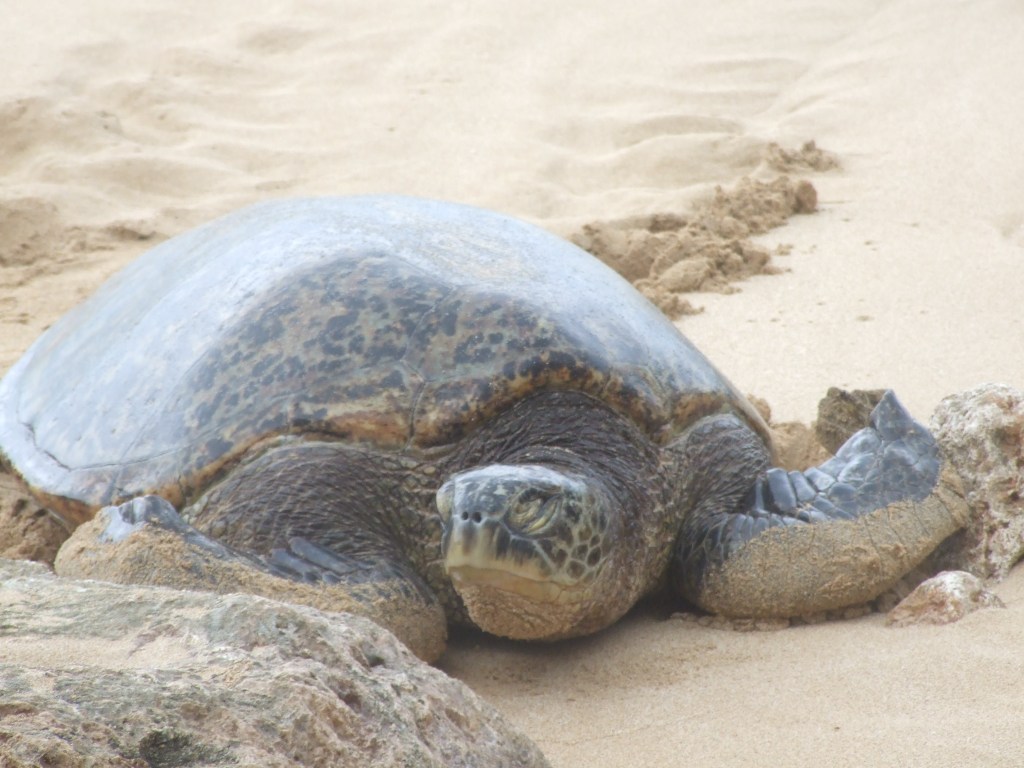
Honu are one of the oldest living marine species on Earth, with ancestors dating back more than 100 million years. Green sea turtles are among the largest sea turtles in the world, often weighing between 300 and 400 pounds and growing up to five feet in length. They have smooth heart shaped shells on their back and powerful flippers. Their flippers are specialised for long distance swimming, they are paddled shaped and move slowly through the water but with great force.
Unlike most reptiles with shells, Honu are unable to retreat back into their shells for safety and instead rely on their strength and camouflage for survival. They have also adapted a distinct awareness of predators and avoid areas where they know predators lurk. Like other reptiles turtles also have a temperature-dependant sex determination: warmer temperatures/sand temperatures produce more females and colder conditions produce more males, which makes climate change particularly worrying for the sustainability of Honu in Hawaii, with air temperatures warming by 1.5 degrees celsius in a century.
Honu always inhabit tropical and subtropical waters , including the Pacific, Atlantic, and Indian oceans. spending most of their lives in shallow coastal areas such as seagrass meadows, where food is abundant. Hawaii supports a genetically distinct population and is one of the most important habitats in the world for Honu, they are highly migratory and can travel thousands of miles between feeding grounds and nesting beaches. (Also often returning to the exact beach where they were born, a behaviour known as natal homing)
In adulthood, Honu are primarily herbivores, with their diet consisting of seagrass, seaweed and algae. Whilst juveniles also dabble in jellyfish and other small invertebrates being omnivores for the extra protein to grow. Their diet also shifts to decrease competition between other Honu for food.
Today, green sea turtles are listed as endangered or threatened in many parts of the world. They face numerous threats, including habitat loss, plastic pollution, entanglement in fishing gear, illegal poaching, and the impacts of climate change on nesting beaches. But in places like Hawaii, Honu are strictly protected and is illegal to touch or harass them. I was lucky enough to be taken to a Honu cleaning station and with a guide dove down to say hi: https://youtu.be/5gMkiXuuk20 (also listen out for a Humpback whale singing).
Beyond their ecological importance, honu hold profound cultural significance in Native Hawaiian traditions. They are often regarded as ʻaumākua, or ancestral family guardians, believed to offer protection and guidance to specific families. Hawaiian legends tell of honu appearing to save people from danger, guide travelers, or deliver warnings. Harming a honu was thought to bring misfortune, while showing kindness or respect could result in lifelong spiritual protection (which I think I have now).
In modern times, the honu has become an enduring symbol of Hawaiian identity and environmental stewardship. Seeing a green sea turtle resting on a beach is often considered a spiritual blessing rather than a tourist attraction. This belief reinforces the importance of observing from a respectful distance and protecting their natural behavior. Lesser-known facts add to their mystique: honu can hold their breath for several hours while resting, each shell pattern is unique like a fingerprint, and ancient Polynesians once observed turtle behavior to predict weather and ocean conditions. Some legends even describe honu as shape-shifters capable of taking human form.
 Oli's Ecology Blog