The common waxbill is a is a small and colourful finch from the estrildid finch family. Best known for its slender red “wax like” beak and a very lively personality.
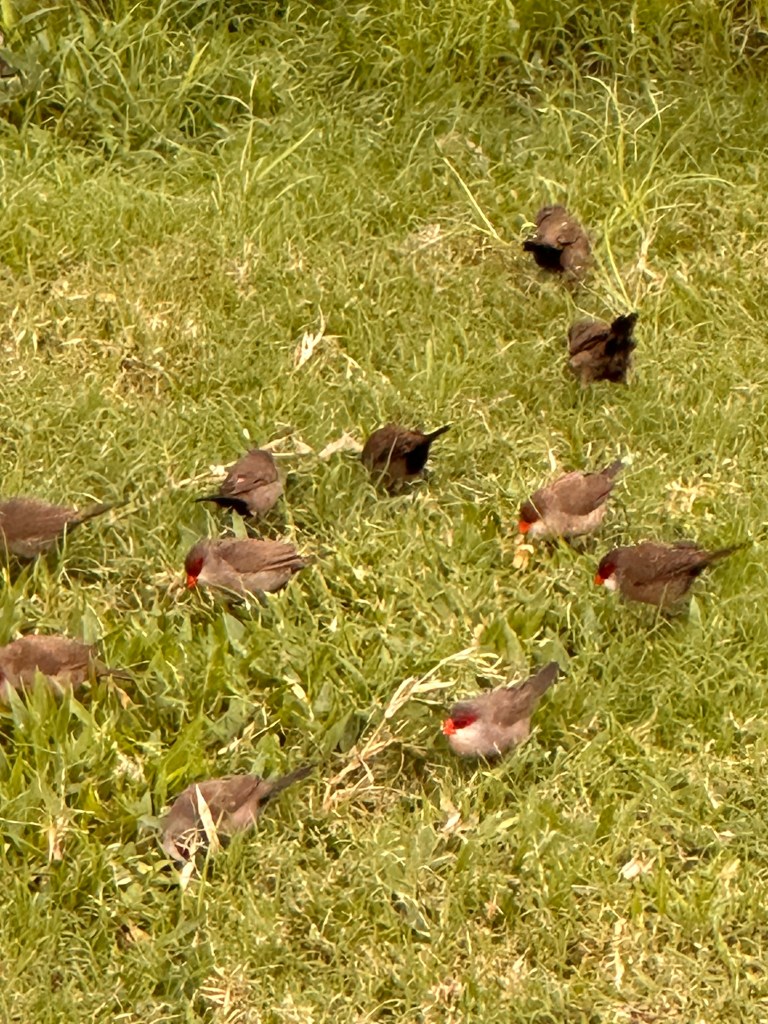
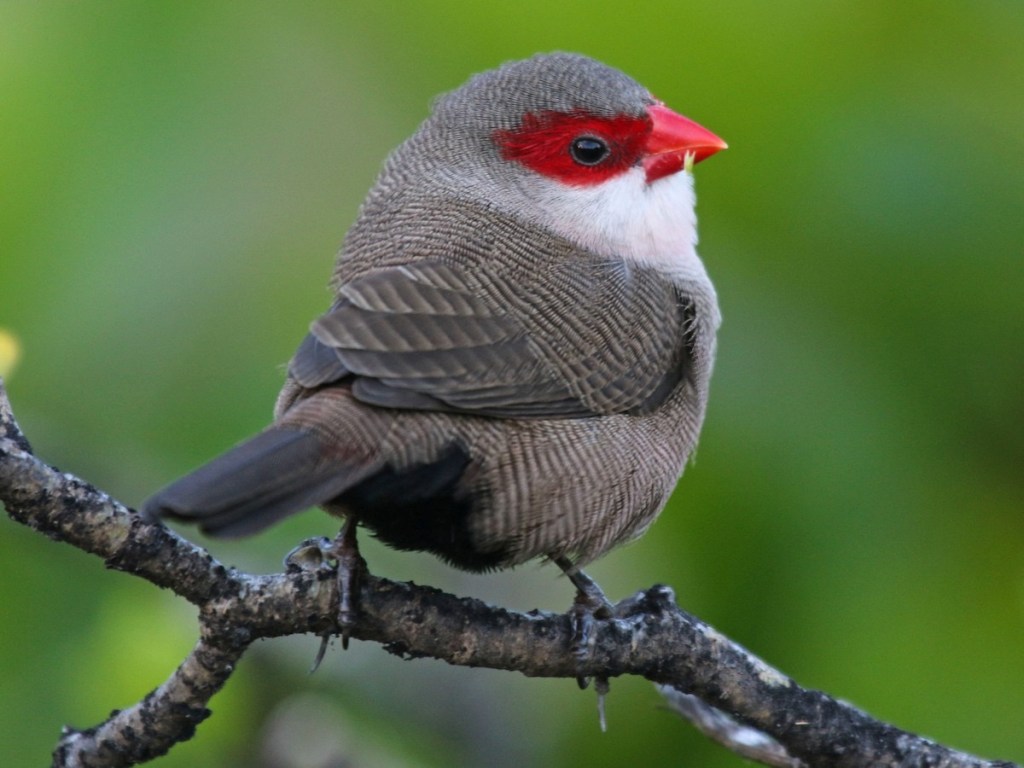
Originally native to sub-Saharan Africa, the Common Waxbill has become one of the most widely introduced finches in the world. They’re about 11-13 cm long and have a long thin tail. Their plumage is overly grey-brown with a lighter/pinkish belly and a noticeable red strip across their eyes.
The beak is smooth, glossy + vivid red, while the legs are pink to reddish in colour. Juvenile waxbills appear much duller than adults, with brownish faces and dark rather than red beaks].
They are highly social birds and are almost always seen in pairs or smallish flocks. Vocally, they are quite subtle only producing soft “tsip” or “tseet” calls. Their songs are very quiet rather than loud or musical. Relying more on body language and flock interaction than on vocal communication.
In their native range, Common Waxbills are found throughout sub-Saharan Africa, particularly in grasslands/savannahs. Due to escapes and releases from captivity (being very adaptable) they have also established populations in other parts of the world, including southern Europe (notably Portugal, Spain, and southern France), parts of South America such as Brazil, several Indian Ocean islands and regions of the Middle East. They adapt easily to human-altered landscapes and are often found in parks and farmland.
The Common Waxbill is one of the most popular finches as pets. While they are not typically hand-tame, they are best kept in pairs or small flocks where their natural social behaviour can be observed. Also, according to the IUCN, the Common Waxbill is classified as Least Concern. Unlike some other finches, such as the Java Sparrow, it has a very large population and an expanding range.
The Common Waxbill plays a role in seed dispersal and shows a strong ability to adapt to environmental changes. In non-native regions, it may compete with local species for nesting space or resources and, in some cases, alter local ecosystems. For this reason, some countries (such as Hawaii) monitor or regulate its presence.
 Oli's Ecology Blog